RV1126 / RV1109
Low-cost 32-bit vision SoC for IP cameras and face-recognition terminals: 14MP ISP, 4K30 H.265 encode and a 2 TOPS NPU, but no PCIe, no USB 3, no HDMI and a legacy NPU toolchain.
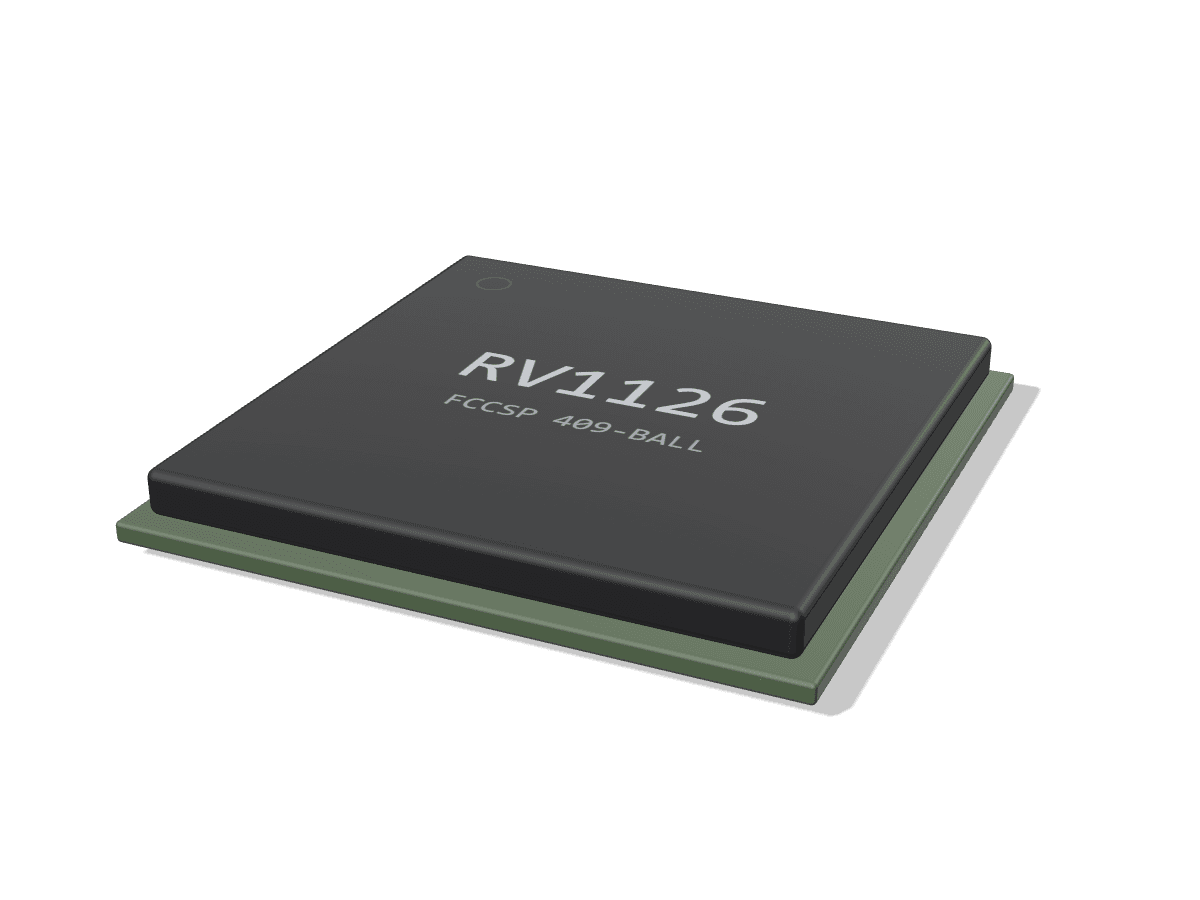
- CPU
- 4x Cortex-A7 (RV1109: 2x)
- GPU
- None (2D RGA only)
- NPU
- 2.0 TOPS INT8/INT16 (RV1109: 1.2)
- Video
- 4K30 H.264/H.265 enc and dec
- PCIe
- None
What the RV1126 / RV1109 is for
Right for
- IP cameras that encode 4K30 H.265 plus a 1080p30 substream from one sensor
- Face-recognition gates and access terminals with an RGB plus IR camera pair (two 4-lane MIPI CSI inputs and a DVP port)
- USB AI camera modules where the board enumerates as a USB device (Firefly CAM-C1126S2U is this design)
- Maintaining or cost-reducing an existing RV1126 or RV1109 product on a known 4.19 BSP
Wrong for
- Anything needing PCIe, SATA or USB 3: the chip has two USB 2.0 controllers and SDIO only
- Designs that need native HDMI: display is MIPI DSI, 24-bit RGB or BT.1120 up to 1080p60, so HDMI needs a bridge chip
- New NPU work that wants RKNN-Toolkit2 or a current kernel NPU driver: RV1126 is limited to the legacy RKNN-Toolkit v1 (last release 1.7.5, 2023)
- 64-bit Linux userspace or general-purpose compute: four 32-bit Cortex-A7 cores, 4 GB maximum DRAM
- New designs that can take the RV1126B instead (separate page): newer CPU and NPU on a maintained toolchain
Cost and constraints
- Memory is one 32-bit channel of DDR3, DDR3L, DDR4, LPDDR3 or LPDDR4, two ranks, 4 GB maximum addressing
- Camera ceiling is set by the ISP: 14MP (4416x3312) on RV1126, 5MP on RV1109
- Mainline Linux boots the SoC with Ethernet and eMMC/SD, but has no USB, NPU, ISP or video codec support and no DSI node in the devicetree yet, so camera products still ship on the vendor 4.19 kernel
- Package is 409-ball FCCSP, 14 x 14 mm at 0.65 mm pitch: RV1126 and RV1109 are pin compatible, so one board can carry either
Inside the RV1126 / RV1109
Drawn by Groundplane from the datasheet rev 1.2. Not Rockchip artwork.
- 32-bit DDR3/DDR4/LPDDR3/LPDDR4
- 4 GB max, 2 ranks
- eMMC 4.51 HS200
- SD 3.0
- FSPI NOR or NAND
- Async NAND 8-bit
- 4x Cortex-A7, NEON and FPU
- 512 KB L2 cache
- RISC-V RV32IMC MCU
- 2.0 TOPS, INT8 and INT16
- H.264/H.265 enc 4K30 + 1080p30
- H.264/H.265 dec 4K30
- JPEG enc and dec
- RGA 2D engine
- IEP de-interlacer
- 14MP ISP, 3-frame HDR
- 3DNR, 2DNR, fisheye correction
- VOP up to 1080p60
- Crypto engine, TRNG
- Secure OTP 32 Kbit
- TrustZone, DDR scrambling
- PMU, 5 voltage domains
- Mailbox A7 to RISC-V
- GZIP and LZ4 decompressor
- DMAC, timers, watchdogs
- GMAC RGMII or RMII
- USB 2.0 OTG
- USB 2.0 host
- SDIO 3.0
- 2x MIPI CSI or LVDS, 4-lane
- 16-bit DVP, BT.1120
- MIPI DSI 4-lane
- 24-bit RGB
- BT.1120
- 6x I2C, 6x UART, 2x SPI
- 12x PWM, 6x SARADC
- I2S TDM, PDM, 2x I2S
Read from the documents
Each value names the document it was read from.
| CPU | 4x Cortex-A7 (ARMv7-A, NEON, FPU), 32 KB I + 32 KB D L1 per core, 512 KB L2; plus a RISC-V RV32IMC MCU | Datasheet Rev 1.2, 1.2.1, 1.2.9 |
|---|---|---|
| CPU clock | 1.5 GHz (Cortex-A7), RISC-V MCU 400 MHz, per the distributor brief; the datasheet lists maximum A7 frequency as TBD | Product brief, p.3 |
| GPU | No 3D GPU. 2D engine (RGA) up to 8192x8192 source, 4096x4096 destination, plus IEP de-interlacer up to 1080p | Datasheet Rev 1.2, 1.2.10 |
| NPU | Up to 2.0 TOPS, INT8 and INT16; OpenVX API; own voltage domain | Datasheet Rev 1.2, 1.2.5 |
| ISP | 14MP (4416x3312), 2- and 3-frame HDR, 3DNR, 2DNR, dehaze, LDCH and fisheye correction, ORB feature points | Datasheet Rev 1.2, 1.2.2 |
| Camera | 2x MIPI CSI / LVDS / SubLVDS, 4 lanes each (MIPI 2.5 Gbps per lane, LVDS 1 Gbps per lane), plus one 8/10/12/16-bit DVP (BT.601/656/1120); up to 3 sensors at once | Datasheet Rev 1.2, 1.1, 1.2.2 |
| Video decode | H.264 and H.265 up to 4096x2304 at 30 fps (H.265 Main and Main10) | Datasheet Rev 1.2, 1.2.3 |
| Video encode | H.264 and H.265 up to 4096x2304 at 30 fps, up to 100 Mbit/s; multi-stream 3840x2160 at 30 fps plus 1080p30 | Datasheet Rev 1.2, 1.2.3 |
| JPEG | Encode up to 8192x8192 (90 Mpixel/s), decode up to 8176x8176 (76 Mpixel/s) | Datasheet Rev 1.2, 1.2.4 |
| Memory | DDR3, DDR3L, DDR4, LPDDR3 or LPDDR4 (one type per design), 32-bit, 2 ranks, 4 GB maximum | Datasheet Rev 1.2, 1.2.8 |
| Storage | eMMC 4.51 up to HS200 (no CMD queue), SD 3.0, FSPI NOR/NAND (x1/x2/x4, 2 CS), 8-bit async NAND | Datasheet Rev 1.2, 1.2.8 |
| Display | One VOP up to 1920x1080 at 60 fps: 4-lane MIPI DSI (1 Gbps per lane), 24-bit RGB parallel, or BT.1120 out | Datasheet Rev 1.2, 1.2.11, 1.2.12 |
| PCIe | None | Datasheet Rev 1.2, 1.2.14 |
| USB | 1x USB 2.0 host (EHCI/OHCI), 1x USB 2.0 OTG | Datasheet Rev 1.2, 1.2.14 |
| Ethernet | 1x GMAC, RGMII 10/100/1000 or RMII 10/100, with TSO and USO offload (external PHY) | Datasheet Rev 1.2, 1.2.14 |
| Audio | I2S0 8-channel TDM, 2x 2-channel I2S, 8-channel PDM, audio PWM, digital codec interface (3 ADC, 2 DAC channels) | Datasheet Rev 1.2, 1.2.13 |
| Other I/O | SDIO 3.0, 2x SPI, 6x I2C, 6x UART, 12x PWM, 6-channel 10-bit SARADC, 2-channel TS-ADC, 32 Kbit OTP | Datasheet Rev 1.2, 1.2.14, 1.2.15 |
| Security | Crypto engine (AES, DES/TDES, SHA, SM2/SM3/SM4, RSA/ECC up to 4096-bit), TRNG, DDR scrambling, secure OTP, TrustZone | Datasheet Rev 1.2, 1.2.9 |
| Process | SMIC 14 nm | Product brief, p.3 |
| Package | FCCSP 409-ball, 14 x 14 mm, 0.65 mm pitch, 0.3 mm balls | Datasheet Rev 1.2, 1.2.15 |
| Thermal | Tj max 125 C; theta JA 33.3, theta JB 7.3, theta JC 3.7 C/W (simulated, 4-layer 45 x 45 mm board) | Datasheet Rev 1.2, 4.1, 4.2 |
| Temperature | Ambient -20 to 85 C (RV1126), -40 to 85 C (RV1126K); Rev 1.4 gave 0 to 80 C for RV1126 | Datasheet Rev 1.8, Table 3-2 |
Variants
| RV1109 | Same package and pin compatible with RV1126. Differs only in CPU (2x Cortex-A7 instead of 4), NPU (1.2 TOPS instead of 2.0), ISP (5MP instead of 14MP) and video codec (5MP H.264/H.265 instead of 4K; the RV1109 datasheet Rev 1.6 gives encode up to 3072x1728 at 30 fps). Rated 0 to 80 C ambient in that datasheet. Mainline Linux models it as rv1126.dtsi with two CPU cores removed. | Datasheet Rev 1.6 |
|---|---|---|
| RV1126K | Industrial-grade RV1126: separate order code in the same FCCSP409 package, -40 to 85 C ambient (datasheet Rev 1.8; RV1126 is -20 to 85 C). Firefly builds its Core-1126K-JD4 industrial SoM on it, with the same CPU, NPU and video specification as the commercial Core-1126-JD4. | Datasheet Rev 1.8 |
What to watch when you design with it
Size a heatsink for the RV1126 / RV1109 with its datasheet θJC and Tj max filled in, and download the STEP.
Power and PMIC
The chip has five voltage domains (CPU core, logic, PMU, NPU and video encoder), with separate CPU and NPU rails for DVFS. Every public RV1126 board we checked that names its PMIC uses the Rockchip RK809-2: the TB-96AIoT-1126CE schematic and both Thinkcore SoMs. Firefly rates its Core-1126-JD4 module at 0.15 W minimum, 0.8 W typical and 3.25 W maximum from a single 5 V input, which is a useful budget for the whole SoC plus DRAM and eMMC.
Sources: Datasheet Rev 1.2, PMIC Rev 2.7, Board schematic, Other V1.2, think-core.com
DDR
One 32-bit channel, two chip selects, 4 GB maximum. DDR3, DDR3L, DDR4, LPDDR3 and LPDDR4 are supported but only one type per board. Public boards use all of them: 1 GB DDR3 on the TB-96AIoT-1126CE and the Thinkcore gold-finger SoM, LPDDR4 on Firefly and Thinkcore stamp-hole modules, DDR4 on the Sonoff iHost. Thinkcore lists 6 layers for its 48 x 48 mm LPDDR4 stamp-hole SoM and 8 layers for its 204-pin DDR3 gold-finger SoM.
Sources: Datasheet Rev 1.2, Board schematic, Other V1.2, think-core.com, think-core.com
High-speed interfaces
The fast interfaces are MIPI only: two 4-lane CSI receivers at up to 2.5 Gbps per lane (also usable as LVDS or SubLVDS at 1 Gbps per lane) and one 4-lane DSI transmitter at 1 Gbps per lane. There is no HDMI, so boards that want HDMI add a bridge: the TB-96AIoT-1126CE uses a Lontium LT9611 to drive HDMI 1.4 from DSI. Ethernet is RGMII to an external gigabit PHY.
Sources: Datasheet Rev 1.2, Board schematic, Other V1.0
Boot and maskrom
The boot ROM boots from FSPI flash, eMMC, SD or async NAND, and falls back to firmware download over the USB OTG port in device mode, so the OTG port must be reachable on any production board. Firefly documents maskrom entry on the CAM-C1126S2U by shorting two test points while powering up; the TB-96AIoT-1126CE has a dedicated recovery button.
Sources: Datasheet Rev 1.2, wiki.t-firefly.com, Other V1.0
Thermal
Maximum junction temperature is 125 C. The datasheet gives a simulated theta JA of 33.3 C/W on a 4-layer 45 x 45 mm test board, and theta JB of 7.3 C/W, so on a small camera board most heat leaves through the PCB; give the ground planes under the ball field a path to the enclosure. Two on-die TS-ADC channels watch the CPU and NPU.
Sources: Datasheet Rev 1.2
Gotchas
The datasheet leaves the maximum Cortex-A7 frequency as TBD; 1.5 GHz comes from the distributor brief and board vendors. The NPU uses the legacy rknpu driver stack (kernel module galcore) and RKNN-Toolkit v1, not RKNN-Toolkit2, so models and code written for RV1106, RK3566 or RV1126B do not carry over. Userspace is 32-bit ARM (the rknpu runtime ships as linux-armhf).
Sources: Datasheet Rev 1.2, Product brief, github.com, github.com
Layout guides for the RV1126 / RV1109's interfaces
Public layout guidance for each interface this chip has, from vendors who publish it, plus our calculators.
LPDDR4
Point-to-point routing; TI notes that on-die termination on both ends means no board termination is needed. Byte lanes length-matched to their strobe and command/address matched to the clock, all over a solid reference plane. Impedance targets differ by vendor: TI AM62x and ADI EE-480 use 40 ohm single-ended and 80 ohm differential, Synaptics SL1680 uses 50 and 85 ohm, AMD Versal 45 and 82 ohm. Use the SoC vendor's own target and simulate.
- AM62x, AM62Lx DDR Board Design and Layout GuidelinesTexas Instruments, SPRAD06, C, 2025
- AM62Ax, AM62Px, AM62Dx LPDDR4 Board Design and Layout GuidelinesTexas Instruments, SPRAD66, B, 2024
- ADSP-2184x/ADSP-SC84x LPDDR4 Board Design GuidelinesAnalog Devices, EE-480, 1, 2026
- SL1680 General PCB Design and LPDDR4 & LPDDR4(x) Interface Layout GuidelinesSynaptics, PN 506-001390-01, E
- DDR length matching calculatorGroundplane calculator
DDR4
DDR4 uses pseudo open-drain data signaling and needs a VPP supply, with command/address routed fly-by or as a balanced tree depending on device count. TI AM62x uses 40 ohm single-ended and 80 ohm differential; AMD Versal uses 50 and 90 ohm, relaxed under the BGA. Match data to strobe per byte and command/address to clock.
- AM62x, AM62Lx DDR Board Design and Layout GuidelinesTexas Instruments, SPRAD06, C, 2025
- Versal Adaptive SoC PCB Design User Guide: PCB Routing Guidelines for DDR4 InterfacesAMD, UG863, 1.12, 2026
- SL1640 General PCB Design and DDR4 & LPDDR4(x) Interface Layout GuidelinesSynaptics, PN 506-001529-01, D
- PCB Design Guidelines (HSSI, EMIF, MIPI, True Differential, PDN) User Guide: Agilex 5 FPGAs and SoCsAltera, 821801, 2026
- DDR length matching calculatorGroundplane calculator
- Via current calculatorGroundplane calculator
DDR3 / DDR3L
Fly-by command/address with termination at the end of the chain, point-to-point data lanes matched to their strobe, and a clean VREF. ST recommends 55 ohm single-ended and 100 ohm differential for DDR3 and DDR3L on STM32MP1 boards, and shows that a 4-layer board is possible with strict layer allocation.
- STM32MP1 Series DDR memory routing guidelinesSTMicroelectronics, AN5122, 3, 2019
- DDR3 Design Requirements for KeyStone DevicesTexas Instruments, SPRABI1, D, 2022
- SL2610 General PCB Design and DDR3L/DDR4 & LPDDR4(x) Interface Layout GuidelinesSynaptics, PN 506-001629-01, A, 2025
- DDR length matching calculatorGroundplane calculator
LPDDR3
Point-to-point and normally unterminated, with command/address matched to the clock and each byte matched to its strobe. ST gives the same targets for LPDDR3 as for DDR3: 55 ohm single-ended and 100 ohm differential. Few current public guides cover LPDDR3, so treat the SoC vendor's reference layout as the stronger source.
- STM32MP1 Series DDR memory routing guidelinesSTMicroelectronics, AN5122, 3, 2019
- DDR length matching calculatorGroundplane calculator
eMMC
A single-ended bus: CLK, CMD, DAT0 to DAT7 and, for HS400, the data strobe. TI and Synaptics both route it at 50 ohm single-ended, match the group, and keep stubs short; Synaptics places a 22 or 33 ohm series resistor on CLK and STRB. At HS400 TI also checks the eMMC I/O supply impedance, not just the traces.
- AM62Px eMMC HS400 Board Design and Simulation GuidelinesTexas Instruments, SPRADP5, A, 2026
- Astra Machina Foundation Series eMMC ConfigurationSynaptics, PN 506-001594-01, D
- i.MX28 Layout and Design GuidelinesNXP (Freescale), AN4215, 0, 2010
SD card / SDIO
Single-ended CLK, CMD and four data lines over a solid ground plane, at constant trace width and matched length. NXP asks for clock-to-neighbor spacing greater than twice the trace height above the plane and 1.5 times for data and CMD, with 45 degree bends. UHS modes switch the I/O to 1.8 V, so a level translator often sits next to the socket.
- NVT4557/NVT4558/NVT4858 voltage-level translator layout guidelineNXP, AN13158, 1.1, 2022
- i.MX28 Layout and Design GuidelinesNXP (Freescale), AN4215, 0, 2010
- SD Physical Layer Simplified SpecificationSD Association, 9.10, 2023
PCIe
AC-coupled differential lanes routed with no stubs, minimal vias and back-drilled or blind vias where speed demands, with lane-to-lane skew handled by the receiver. Targets differ by guide: TI Jacinto 7 uses 85 ohm differential for lanes and 100 ohm for the reference clock, while TI's earlier SoC guide tabulates 100 ohm and, for some devices, 95 ohm. Match the target to your connector and stackup.
- Jacinto7 AM6x, TDA4x, and DRA8x High-Speed Interface Design GuidelinesTexas Instruments, SPRACP4, A, 2024
- High-Speed Interface Layout GuidelinesTexas Instruments, SPRAAR7, J, 2023
USB 2.0
One D+/D- pair at 90 ohm differential, routed in parallel for its whole length with minimal deviations at the connector and package. NXP keeps clocks and periodic signals at least 50 mils away and other signals at least 20 mils away from the pair.
- High-Speed Layout Guidelines for Signal Conditioners and USB HubsTexas Instruments, SLLA414, A, 2026
- High-Speed Interface Layout GuidelinesTexas Instruments, SPRAAR7, J, 2023
- i.MX28 Layout and Design GuidelinesNXP (Freescale), AN4215, 0, 2010
MIPI DSI
MIPI D-PHY clock and data lanes are routed as 100 ohm differential pairs over a solid reference; TI Jacinto 7 allows no stubs, 2 vias per trace and 40 ps lane-to-lane skew. Connectors and flex cables to the panel are usually the largest discontinuity, so keep the board segment short and clean.
- Jacinto7 AM6x, TDA4x, and DRA8x High-Speed Interface Design GuidelinesTexas Instruments, SPRACP4, A, 2024
- PCB Design Guidelines (HSSI, EMIF, MIPI, True Differential, PDN) User Guide: Agilex 5 FPGAs and SoCsAltera, 821801, 2026
MIPI CSI-2
Same D-PHY rules as DSI: 100 ohm differential lanes in both TI guides, with lane-to-lane skew bounded (40 ps in TI Jacinto 7). Size the lane count and lane rate from the sensor's output format before routing.
- Jacinto7 AM6x, TDA4x, and DRA8x High-Speed Interface Design GuidelinesTexas Instruments, SPRACP4, A, 2024
- High-Speed Interface Layout GuidelinesTexas Instruments, SPRAAR7, J, 2023
- PCB Design Guidelines (HSSI, EMIF, MIPI, True Differential, PDN) User Guide: Agilex 5 FPGAs and SoCsAltera, 821801, 2026
- MIPI CSI-2 bandwidth calculatorGroundplane calculator
LVDS
Tightly coupled differential pairs terminated at the receiver in 100 ohm, with TI's EMI guide asking for 100 ohm differential traces within 5 percent. Keep pairs matched and away from other aggressors, and avoid stubs and reference plane gaps along the route to the panel connector.
- LVDS Owner's Manual: Including High-Speed CML and Signal ConditioningTexas Instruments, SNLA187, 4th edition, 2008
- High-Speed Layout Guidelines for Reducing EMI for LVDS SerDes DesignsTexas Instruments, SNLA302, 2018
- LVDS SerDes Gen I PCB and Interconnect Design-In GuidelinesTexas Instruments, SNLA008, A, 2018
Ethernet (RGMII / RMII)
TI routes MAC-to-PHY (MII family) traces at 50 ohm single-ended, under 6 inches, matched within 20 mils for gigabit, and the PHY-side MDI pairs at 100 ohm differential. RGMII also needs a 1.5 to 2.0 ns clock-to-data delay, added on the board or inside the MAC or PHY (RGMII-ID); decide which before layout so it is not applied twice.
- Ethernet PHY PCB Design Layout ChecklistTexas Instruments, SNLA387, 2021
- PCB Design Guideline for RGMII InterfaceRenesas, R01AN6272EJ0141, 1.41, 2026
- i.MX28 Layout and Design GuidelinesNXP (Freescale), AN4215, 0, 2010
Board-level design guides
Impedance and timing, power, thermal and ESD guidance that applies to any board around this chip.
Impedance and timing
Every high-speed interface on the board comes down to the same two numbers: the trace impedance your stackup actually gives, and the delay each trace adds. Set the stackup with your fab first, then route to its impedance table and match lengths in time, not millimeters, where the layers differ.
- High-Speed Interface Layout GuidelinesTexas Instruments, SPRAAR7, J, 2023
- PCB impedance calculatorGroundplane calculator
- PCB propagation delay calculatorGroundplane calculator
Power delivery
For each switching regulator, place and route the input capacitor first, keep the switching current loop small, and keep the switch node short. Give the SoC rails solid planes and decoupling at the balls, and size current-carrying copper and vias for the real load.
- Five steps to a great PCB layout for a step-down converterTexas Instruments, SLYT614, 2015
- AN-1149 Layout Guidelines for Switching Power SuppliesTexas Instruments, SNVA021, C, 2013
- AN-1229 SIMPLE SWITCHER PCB Layout GuidelinesTexas Instruments, SNVA054, C, 2013
- Buck converter calculatorGroundplane calculator
- LDO power dissipation calculatorGroundplane calculator
- PCB trace width calculatorGroundplane calculator
- Via current calculatorGroundplane calculator
Thermal
Theta-JA is measured on a JEDEC test board that carries most of the heat, so it does not transfer directly to a product board; use it to compare packages and use the psi metrics for estimates. Thermal vias under the package, copper area and copper thickness move the most heat into the board.
- Semiconductor and IC Package Thermal MetricsTexas Instruments, SPRA953, D, 2024
- AN-2020 Thermal Design By Insight, Not HindsightTexas Instruments, SNVA419, C, 2013
- Heatsink thermal resistance calculatorGroundplane calculator
- LDO power dissipation calculatorGroundplane calculator
ESD protection
Place the TVS as close to the connector as design rules allow, route from the connector to the TVS with no stub, and keep the protected IC further from the TVS than the TVS is from the connector. Choose parts by clamping performance and by capacitance low enough for the interface speed.
- ESD Protection Layout GuideTexas Instruments, SLVA680, A, 2022
- Reading and Understanding an ESD Protection Data SheetTexas Instruments, SLLA305, A
- TPD12S016 PCB Layout Guidelines for HDMI ESDTexas Instruments, SLLA324, 2012
- PCB conductor spacing calculator (IPC-2221)Groundplane calculator
Rockchip's hardware design guide
Rockchip's hardware design guide, EVB reference schematics and DDR templates come from Rockchip or an authorized agent, usually under NDA, or through your SoM vendor. We do not link copies circulating elsewhere. The vendor schematics and open designs on the Boards tab are real, shipped layouts on the RV1126 / RV1109 and the best public reference.
BSP, mainline and toolkits
| Area | Status | Links |
|---|---|---|
| Vendor BSP kernel | Linux 4.19.111 with Buildroot. Firefly publishes the Rockchip RV1126/RV1109 Linux SDK as a repo manifest; its latest tag is linux_release_v2.2.5g (manifest dated 2024-10-11), still on 4.19.111. EASY-EAI publishes the same 4.19.111 kernel for its Nano board.Checked 2026-10-13 | |
| Mainline Linux | Linux 6.3: SoC devicetree, clocks, pinctrl, power domains, GMAC and the Edgeble Neu2 board. Linux 6.6: VOP-lite display controller node. Linux 6.7: RV1126 support in the Rockchip MIPI DSI driver, but rv1126.dtsi still has no DSI host or D-PHY node and no board enables a panel. Linux 6.8: RV1109 devicetree and the Sonoff iHost. Linux 6.13: Relfor Saib (RV1109). The Alientek DLRV1126 board is merged for 7.3. Not in mainline as of this check: USB, NPU, ISP and CSI capture, and the video codecs.Checked 2026-10-13 | |
| U-Boot | Mainline U-Boot has RV1126 support since v2023.04, with two board defconfigs: Edgeble Neu2 IO (neu2-io-rv1126_defconfig) and, since v2024.04, Sonoff iHost (sonoff-ihost-rv1126_defconfig). Vendor SDKs ship Rockchip U-Boot.Checked 2026-10-13 | |
| NPU toolkit | RKNN-Toolkit v1, last release 1.7.5 (2023-08-02), with the rknpu runtime and galcore driver for RV1109/RV1126. RKNN-Toolkit2 (README version v2.5.0) does not list RV1126 or RV1109 and points them back to the v1 toolkit and rknpu (the airockchip copies of the repositories linked here; the 1.7.5 release is published on rockchip-linux/rknn-toolkit). Firefly SDKs dated 2022-03-24 or later default to NPU driver 1.7.0.Checked 2026-10-13 | |
| Video (MPP) | Camera and codec pipelines in the vendor SDK go through RKMedia on top of the vendor kernel; Firefly documents RKMedia examples for the Core-1126-JD4.Checked 2026-10-13 | |
| Distributions | Vendor images are Buildroot with Qt by default. Firefly also documents a Debian 10 image for the Core-1126-JD4. No Armbian or vendor Ubuntu image was found for RV1126.Checked 2026-10-13 | |
| Community | Firefly forum and wiki carry the most English RV1126 material; the linux-rockchip list carries mainline work.Checked 2026-10-13 |
RV1126 / RV1109 on GitHub
Repositories for this chip: vendor code, mainline work, toolkits, distributions and open hardware.
- Kernelrockchip-linux/kernelRockchip BSP kernel; the RV1126 and RV1109 SDK uses develop-4.19, and develop-6.6 and develop-6.12 also carry rv1126 device trees. Last commit 2026-08.
- Kerneltorvalds/linuxMainline Linux has rv1126.dtsi and Edgeble Neu2 boards. Last commit 2026-10.
- Bootloaderrockchip-linux/u-bootRockchip U-Boot; next-dev has arch/arm/mach-rockchip/rv1126. Last commit 2026-08.
- Bootloaderrockchip-linux/rkbinDDR init, loaders and TEE; bin/rv11 holds about 25 rv1126 binaries. Last commit 2026-08.
- Bootloaderu-boot/u-bootMainline U-Boot has RV1126 SoC support and the Edgeble Neu2 IO board config. Last commit 2026-10.
- NPUrockchip-linux/rknn-toolkitFirst generation RKNN-Toolkit (v1.7.5), the model converter for the RV1126 and RV1109 NPU; RKNN-Toolkit2 does not support this chip. Last commit 2023-12.
- NPUrockchip-linux/rknpuRKNPU v1 driver and C API; linux-armhf-puma is the RV1109 and RV1126 runtime, with a mini variant to save flash. Last commit 2023-08.
- NPUairockchip/rknn_model_zooReference model conversions that still list RV1109 and RV1126 for most vision models. Last commit 2026-10.
- Mediarockchip-linux/mppMedia Process Platform; RV1109 and RV1126 are listed in the README for hardware decode and encode. Last commit 2026-09.
- Mediaairockchip/librgaRGA 2D acceleration library with RV1126 and RV1109 in its supported chip list. Last commit 2026-06.
- Distributionopenwrt/openwrtOpenWrt rockchip/armv7 target exists for RV1126 with a Herospeed IMX415 camera board. Last commit 2026-10.
- Distributionarmbian/buildArmbian has a rockchip-rv1126 family on mainline U-Boot, with the EASY-EAI Nano as the community board. Last commit 2026-10.
- Toolsrockchip-linux/rkdeveloptoolRockchip open source USB flashing tool for maskrom and loader mode, the Linux and macOS alternative to RKDevTool. Last commit 2025-03.
- CommunityOpenHD/OpenHD-RV1126-OSOpenHD digital FPV video link OS built from the Rockchip RV1126 Linux SDK. Last commit 2026-02.
RV1126 / RV1109 system on modules
Any of these can sit on a carrier board we design.
| Module | Vendor | Connector | RAM | Design files | Price | Buy |
|---|---|---|---|---|---|---|
| Core-1126-JD4 | Firefly | SO-DIMM 260 (gold finger, 0.5 mm pitch) | 1 to 4 GB LPDDR4 | USD 119, 1 GB / 8 GB (Firefly store) | ||
| Core-1126K-JD4 | Firefly | SO-DIMM 260 (gold finger, 0.5 mm pitch) | 1 to 4 GB LPDDR4 | USD 129, 1 GB / 8 GB (Firefly store) | ||
| CAM-C1126S2U | Firefly | Dual-lens USB camera module, 84.0 x 22.45 x 19.35 mm | 1 or 2 GB DDR4 | USD 179, 1 GB / 8 GB (Firefly store) | ||
| CAM-C1109S2U | Firefly | Dual-lens USB camera module (RV1109) | 1 GB | USD 89, 1 GB / 8 GB (Firefly store) | ||
| TC-RV1126 Stamp Hole Core Board | Thinkcore | 172-pin stamp hole (castellated) | 1 or 2 GB LPDDR4 | |||
| TC-RV1126 Gold Finger Core Board | Thinkcore | 204-pin gold finger | 1 GB DDR3 |
Every public RV1126 / RV1109 board
| Board | Vendor | Type | RAM | Notable I/O | Design files | Price | Buy |
|---|---|---|---|---|---|---|---|
| AIO-1126-JD4 | Firefly | Dev kit, Core-1126-JD4 on its carrier | 1 or 2 GB | Gigabit and 100M Ethernet, PoE option, 2x MIPI CSI, DVP, MIPI DSI, Mini PCIe for 4G, 9 to 24 V DC input | USD 169, 1 GB / 8 GB (Firefly store) | ||
| TB-96AIoT-1126CE | BeiQi Technology | SBC, 96Boards CE, 85 x 54 mm | 1 GB DDR3 | HDMI 1.4 via LT9611 bridge, Gigabit Ethernet, Wi-Fi 5 and Bluetooth 5.0, 2x USB 2.0 host, micro-USB OTG | schematic PDF and hardware user manual | ||
| EASY-EAI Nano (RV1126) | EASY-EAI | Dev kit, Core board, development board or kit; commercial or industrial grade | 1 or 2 GB | USD 36.60, default listing option (Tindie) | |||
| TC-RV1126 Development Board | Thinkcore | Dev kit, 135 x 95 mm | |||||
| RV1126 Development Board | Thinkcore | Dev kit, 108 x 124 mm | |||||
| RV1126 Evaluation Board | Thinkcore | Dev kit | 2 GB | 8 GB eMMC | |||
| iHost Smart Home Hub | Sonoff (ITEAD) | SBC, Enclosed smart home hub; RV1109 or RV1126 versions | 2 GB DDR4 (RV1109) or 4 GB DDR4 (RV1126) | Mainline Linux devicetree since 6.8 |
Prices and links as checked on the dates in our data; the latest check on this page was 2026-10-13.
Buying the chip
Rockchip's own RV11 series product page now lists RV1126B, RV1106B and RV1103B, not RV1126 or RV1109, and we found no public end-of-life notice. Chip-down volume buying goes through Rockchip agents; for small runs the practical route is a SoM from Firefly, Thinkcore or EASY-EAI.
- LCSC
- Lists RV1126 as part C2859017 at USD 20.66 for one piece, out of stock on the check date, with a stop-production lifecycle flag in its product data.
- Sanshin Electronics
- Japanese Rockchip distributor; its 2020 Rockchip brochure lists RV1126 and RV1109 as in mass production and takes inquiries. No public price or MOQ.
Datasheet, TRM and design documents
Linked where they are publicly hosted; we do not rehost Rockchip documents. These are third-party documents: we are not responsible for their accuracy, availability or confidentiality status. Disclosure.
- DatasheetRockchip RV1126 DatasheetRev 1.2 · 2020-05 · hosted by LCSC · checked 2026-10-13
- Product briefRockchip product overview (RV1126 and RV1109 pages, Japanese)2020-08 · hosted by Sanshin Electronics (distributor) · checked 2026-10-13
- OtherCore-1126-JD4 / Core-1126K-JD4 specificationV1.2 · 2024-09-05 · hosted by Firefly · checked 2026-10-13
- OtherCAM-C1126S2U intelligent dual-lens camera module specificationV1.0 · 2021-06-29 · hosted by Firefly · checked 2026-10-13
- Board schematicTB-96AIoT-1126CE schematics (RV1126 with RK809-2, DDR3, LT9611)hosted by 96Boards · checked 2026-10-13
- OtherTB-96AIoT-1126CE hardware user manualV1.0 · hosted by 96Boards · checked 2026-10-13
- DatasheetRockchip RV1126 DatasheetRev 1.8 · 2023-12-18 · community mirror (rockchip.fr), not hosted by Rockchip · checked 2026-10-13
- DatasheetRockchip RV1109 DatasheetRev 1.6 · 2023-07-29 · community mirror (rockchip.fr), not hosted by Rockchip · checked 2026-10-13
- TRMRockchip RV1109/RV1126 TRM Part 1V1.0 · 2020-06-05 · community mirror (rockchip.fr), not hosted by Rockchip · checked 2026-10-13
- TRMRockchip RV1109/RV1126 TRM Part 2V1.0 · 2020-06-05 · community mirror (rockchip.fr), not hosted by Rockchip · checked 2026-10-13
- PMICRockchip RK809 DatasheetRev 2.7 · 2026-01-13 · community mirror (rockchip.fr), not hosted by Rockchip · checked 2026-10-13
Questions about the RV1126 / RV1109
Yes. We have designed and brought up a board on the RV1126 under Linux. Our newer work is on the RV1126B.
LCSC hosts Rockchip's RV1126 datasheet Rev 1.2 (May 2020) on its product page for part C2859017. Rockchip has revised it up to Rev 1.8 (December 2023: operating temperature update; Rev 1.7 removed the CAN controller from the feature list), and Rev 1.8 is linked here from the community mirror rockchip.fr, together with the RV1109 datasheet Rev 1.6 and the RV1109/RV1126 TRM V1.0. The feature set in Rev 1.2 matches the later revisions apart from those changes.
They share the 409-ball package and pinout. RV1109 has two Cortex-A7 cores instead of four, a 1.2 TOPS NPU instead of 2.0 TOPS, a 5MP ISP instead of 14MP, and a 5MP video codec instead of 4K30. A board designed for RV1126 can be built with either part.
No. RV1126B is a newer, separate part with its own datasheet and its own page on this site. It moves to 64-bit Cortex-A53 cores and is supported by RKNN-Toolkit2, which does not support RV1126. See the RV1126B page for its pin-compatible RV1126B-P variant.
Partly. Since Linux 6.3 mainline boots RV1126 with clocks, pinctrl, Ethernet, eMMC and SD, Linux 6.6 added the display controller node and Linux 6.7 RV1126 support in the MIPI DSI driver, though no DSI node is in the devicetree yet. USB, the NPU, the ISP and the video codecs are not in mainline, so a camera product still needs the vendor 4.19 kernel. Mainline U-Boot supports it since v2023.04.
RKNN-Toolkit (version 1), last released as 1.7.5 in August 2023, with the rknpu runtime. RKNN-Toolkit2 covers RK3566/RK3568, RK3588, RV1103/RV1106 and RV1126B, and explicitly sends RV1109 and RV1126 users back to version 1.
Neither. Video out is MIPI DSI, 24-bit RGB or BT.1120 up to 1080p60, and high-speed I/O is limited to USB 2.0, SDIO 3.0 and one RGMII Ethernet MAC. Boards that need HDMI add a bridge such as the LT9611 used on the TB-96AIoT-1126CE.
Related chips and reading
- RV1126BAI IP cameras, multi-camera vision
- RV1106 / RV1103Small AI cameras, tiny Linux nodes, IP KVMs
- RK3566HMI, e-ink readers, handhelds, CM4-class SoMs, small routers
- RK3568Routers, NAS, gateways, NVR, industrial HMI
- RK3562Cost-down HMI, tablets, industrial gateways
We'll design your RV1126 board.
Tell us the interfaces, power budget and volume. An engineer replies with questions or a proposal.
Links and facts on this page checked 2026-10-13. Spotted something out of date? Tell us through the contact form.
Compiled from publicly available sources: datasheets, technical reference manuals, vendor product pages, schematics and source code published by their owners and third parties. We link to documents where others host them and do not host, endorse or vouch for them. Everything on these pages, including our own specs, summaries, block diagrams, comparisons, calculators and design notes, is for reference only and may contain errors or be out of date. It is provided as is, and Groundplane is not responsible for errors in it, for third-party documents, or for any design, board or decision based on it. Always check the manufacturer's current datasheet, reference manual and design guidance before you design a board. Rockchip, Allwinner, Raspberry Pi and other product names are trademarks of their owners; we are not affiliated with any of them. See our disclosure.