Our cloud gaming infrastructure runs on the RV1103, the smaller part in this family. Case study: Cloud Gaming Infrastructure
RV1106 / RV1103
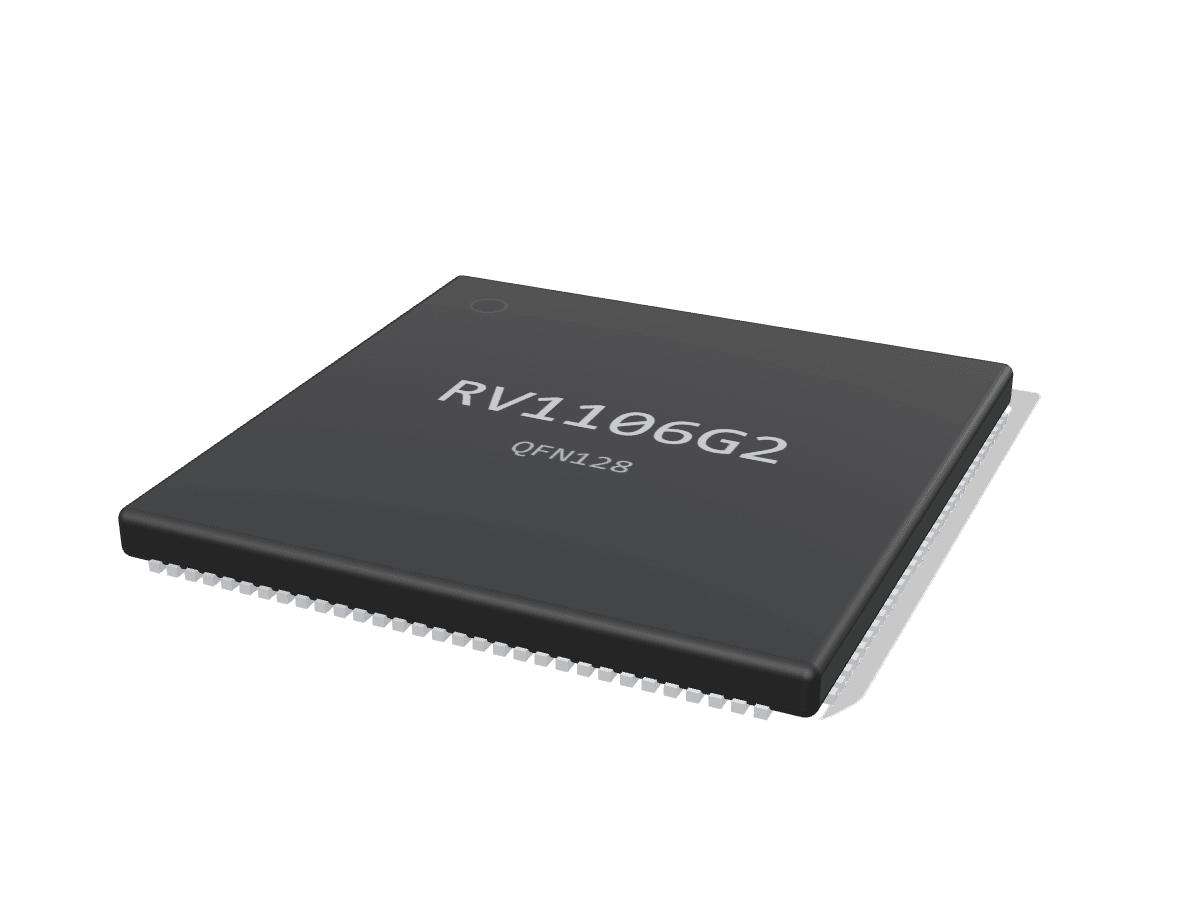
A single-core Cortex-A7 camera SoC with the DRAM inside the package: a QFN, no DDR routing and a 0.5 to 1 TOPS NPU, but a hard 64, 128 or 256 MB memory ceiling, no video decoder and 10/100 Ethernet only.
- CPU
- 1x Cortex-A7 + MCU
- GPU
- None (2D RGA only)
- NPU
- 0.5 or 1.0 TOPS
- Video
- Enc 5M@30 (G2) or 8M@15 (G3), no decode
- PCIe
- None
What the RV1106 / RV1103 is for
Right for
- Battery and PoE IP cameras: H.265/H.264 encode at 5MP@30 (RV1106G2) with a hardware ISP, on a part whose DRAM is already in the package
- Low-cost two-layer-friendly Linux designs: QFN128 (RV1106) or QFN88 (RV1103) with no external DDR to route
- Small NPU inference at the edge: 0.5 TOPS (RV1103) or 1.0 TOPS (RV1106G2 and G3 per datasheet Rev 2.0) with INT4/INT8/INT16, enough for YOLO-class detection on one camera
- Network appliances that capture and encode video: IP KVMs and RTSP bridges (JetKVM and Luckfox PicoKVM ship on the RV1106)
- Tiny 10/100 Ethernet gateways: on-chip MAC and PHY, USB 2.0 OTG and a 64 MB RV1103 cost floor
Wrong for
- Anything needing more than 256 MB of RAM: there is no external DRAM interface, memory is fixed by the part number
- Playback or transcoding: the datasheet lists an encoder only, with no video decoder
- Displays above 1280x720 or HDMI/MIPI DSI output: only parallel RGB, serial RGB and MCU LCD are listed
- Gigabit Ethernet, PCIe, SATA or USB 3: none exist on the chip
- Products that need a mainline kernel today: as of Linux 7.3-rc7 only RV1106 pinctrl and clock drivers are upstream, with no RV1106 SoC devicetree
Cost and constraints
- Memory is chosen by ordering code, not by layout: RV1103G1 64 MB DDR2, RV1106G2 128 MB DDR3L, RV1106G3 256 MB DDR3L
- RV1106G3 is not a straight upgrade: it doubles RAM (and NPU, per datasheet Rev 1.8; Rev 2.0 rates both parts at 1.0 TOPS) but its maximum input and encode is 8MP@15 against 5MP@30 on the G2
- Software is the Rockchip IPC SDK on Linux 5.10.160 and U-Boot 2017.09, distributed in practice through board vendors (Luckfox, LubanCat)
- Single-unit LCSC pricing on 2026-10-13: RV1106G2 USD 14.24, RV1106G3 USD 25.29, so the G3 nearly doubles the SoC line of the BOM
- Rockchip's English product index now lists RV1103B, RV1106B and RV1126B in the RV11 series, not the RV1103 or RV1106
Inside the RV1106 / RV1103
Drawn by Groundplane from the datasheet rev 1.8. Not Rockchip artwork.
- eMMC 4.51, 8-bit, HS200
- SD 3.0, 4-bit
- FSPI SPI NAND / NOR
- 1x Cortex-A7, NEON and FPU
- 32 KB + 32 KB L1, 128 KB L2
- MCU with 16 KB cache
- 1.0 TOPS (G2 and G3, Rev 2.0)
- INT4, INT8, INT16
- H.265 / H.264 encoder
- JPEG encoder
- 2D graphics engine (RGA)
- RKIVE vision engine
- ISP: 5MP@30 (G2), 8MP@15 (G3)
- VICAP, HDR, 3DNR, LDCH
- DDR3L in package, 16-bit
- 128 MB (G2), 256 MB (G3)
- 256 KB shared SRAM
- VOP, one layer, to 1280x720
- Crypto: AES, SHA, RSA/ECC/SM2
- TRNG, 8 Kbit OTP, TrustZone
- 4 PLLs, 24 MHz oscillator
- RTC, POR, watchdogs
- Audio codec: 2 ADC, 1 DAC
- TS-ADC, SARADC
- USB 2.0 host / device
- 10/100 Ethernet, PHY inside
- SDIO 3.0 for Wi-Fi
- 2x MIPI CSI 2-lane or 1x 4-lane
- DVP 8 to 16-bit, BT.1120
- RGB 18-bit or MCU LCD
- 6x UART, 5x I2C, 2x SPI
- 12x PWM, 2x SARADC
- I2S 8-ch, mic in, line out
Read from the documents
Each value names the document it was read from.
| CPU | 1x Cortex-A7 (Armv7-A) with NEON and FPU, 32 KB I + 32 KB D L1, 128 KB L2; plus an MCU with 16 KB cache. The datasheet states no clock | Datasheet Rev 1.8, 1.2.1, 1.2.3 |
|---|---|---|
| NPU | 1.0 TOPS for RV1106G2 and RV1106G3 (Rev 2.0 corrects Rev 1.8, which gave the G2 0.5 TOPS); INT4, INT8 and INT16 | Datasheet Rev 2.0, 1.2.5 |
| NPU (RV1103) | Up to 0.5 TOPS; INT4, INT8 and INT16 | Datasheet Rev 1.1, 1.1 |
| GPU | No 3D GPU. 2D graphics engine: 8192x8192 source, 4096x4096 destination, scaling 1/16 to 16, rotation, alpha blend | Datasheet Rev 1.8, 1.2.7 |
| Video encode | H.265 Main and H.264 High, level 5.0; RV1106G2 up to 5MP@30, RV1106G3 up to 8MP@15; JPEG to 4MP@60; up to 60 Mbps | Datasheet Rev 1.8, 1.2.4 |
| Video encode (RV1103) | H.265/H.264 up to 4MP@30; JPEG to 4MP@60 | Datasheet Rev 1.1, 1.2.4 |
| Video decode | None listed: the datasheet describes an encoder only | Datasheet Rev 1.8, 1.2.4 |
| Camera | 2x MIPI CSI D-PHY v1.2, 2 lanes at 1.5 Gbps each, combinable to one 4-lane (MIPI or LVDS); 1x DVP 8/10/12/16-bit to 150 MHz (BT.601/656/1120); up to 3 sensors | Datasheet Rev 1.8, 1.1, 1.2.8 |
| ISP | Max input RV1106G2 3072x1728@30, RV1106G3 3840x2160@15; 2-frame HDR, 3DNR, 2DNR, LSC, dehaze, LDCH; up to 4 sensors on the shared ISP | Datasheet Rev 1.8, 1.2.9 |
| Memory | In-package 16-bit DDR3L: 1 Gb (128 MB) on RV1106G2, 2 Gb (256 MB) on RV1106G3. No external DRAM interface | Datasheet Rev 1.8, 1.2.2, 2.1 |
| Memory (RV1103) | In-package 16-bit DDR2, 512 Mb (64 MB), orderable as RV1103G1 | Datasheet Rev 1.1, 1.2.2, 2.1 |
| Storage and boot | eMMC 4.51 (HS200, 1/4/8-bit), SD 3.0 4-bit, FSPI serial flash 1/2/4-bit. BootROM boots SPI, eMMC or SD; download over USB or UART | Datasheet Rev 1.8, 1.2.2 |
| Display | Parallel RGB 18-bit (RGB666) or 16-bit (RGB565), serial RGB, MCU LCD; max 1280x720; one Win layer | Datasheet Rev 1.8, 1.2.10, 1.2.11 |
| PCIe | None | Datasheet Rev 1.8 |
| USB | 1x USB 2.0 host/device (HS, FS, LS), EHCI and OHCI | Datasheet Rev 1.8, 1.2.13 |
| Ethernet | 1x 10/100 MAC with embedded PHY (RMII) | Datasheet Rev 1.8, 1.2.13 |
| Audio | I2S0 8-channel TX and RX to 192 kHz; codec with two 24-bit ADC and one 24-bit DAC, differential or single-ended mic input | Datasheet Rev 1.8, 1.2.12 |
| Other I/O | SDIO 3.0 4-bit, 6x UART (to 4 Mbps), 5x I2C, 2x SPI, 12x PWM, 2-channel 10-bit SARADC, RTC (32.768 kHz), TS-ADC, 8 Kbit OTP | Datasheet Rev 1.8, 1.2.3, 1.2.13, 1.2.14 |
| Security | Crypto engine (AES, DES/TDES, SHA-1/256, MD5, HMAC, PKA to 4096-bit for RSA/ECC/SM2), TRNG, secure OTP, TrustZone | Datasheet Rev 1.8, 1.2.3 |
| Power domains | Three separate voltage domains: VDD_ARM, VDD_LOGIC, VDD_PMU; DVFS on the CPU domain | Datasheet Rev 1.8, 1.2.1, 1.2.3 |
| Package | RV1106: QFN128, 12.3 x 12.3 mm, 0.35 mm pitch, MSL3, 1520 per tray | Datasheet Rev 1.8, 1.2.14, 2.1, 2.4 |
| Package (RV1103) | QFN88, 9 x 9 mm, 0.35 mm pitch, 2600 per tray | Datasheet Rev 1.1, 1.2.12, 2.1 |
| Thermal | RV1106 QFN128: theta-JA 27.3, theta-JB 12.5, theta-JC 8.4 C/W (JEDEC 2S2P, simulated); Tj max 125 C | Datasheet Rev 1.8, 4.1, 4.2 |
Variants
| RV1106G2 | 1.0 TOPS NPU per datasheet Rev 2.0 (0.5 TOPS in Rev 1.8 and earlier), 1 Gb (128 MB) DDR3L in package, input and encode up to 5MP@30 (3072x1728). QFN128. | Datasheet Rev 2.0 |
|---|---|---|
| RV1106 (BGA313) | Added in datasheet Rev 2.0: the RV1106 die in a BGA313 package with external 16-bit DDR2-1056, DDR3/DDR3L-2133 or DDR4-2400 (up to 1024 MB addressing) instead of in-package DRAM; 1.0 TOPS NPU, 8MP@15. Package quantity still TBD in the order table. | Datasheet Rev 2.0 |
| RV1106G3 | 1.0 TOPS NPU, 2 Gb (256 MB) DDR3L in package, input and encode up to 8MP@15 (3840x2160). Same QFN128 and pinout as the G2; the extra resolution costs half the frame rate. | Datasheet Rev 1.8 |
| RV1103 (RV1103G1) | 0.5 TOPS NPU, 512 Mb (64 MB) DDR2 in package, 4MP@30 ISP and encode, QFN88 9 x 9 mm. Its feature list has no eMMC boot, DVP, display output, RTC or I2S0, and supports two sensors instead of three. Datasheet Rev 1.5 (2025-12-12, mirror) also trims the listed peripherals to 4 UART, 3 I2C, 1 SPI and 11 PWM (Rev 1.1: 6, 5, 2 and 12). | Datasheet Rev 1.5 |
| RV1103B | A newer, separate chip: single Cortex-A7 plus MCU, INT8 NPU (the datasheet gives no TOPS figure; the product page says 0.5 TOPS), embedded DDR by suffix (G1 512 Mb DDR2, G2 1 Gb DDR3L, G3 2 Gb DDR3L), eMMC 4.51, H.264/H.265 encode up to 3840x2160@25, ISP input up to 3840x2160@20, two MIPI CSI, QFN88 9 x 9 mm, -20 to 85 C ambient. Mainline Linux treats it as its own SoC (rockchip,rv1103b) with its own pinctrl and clock driver. | Datasheet Rev 1.3 |
| RV1106B | The RV1103B with an LPMCU and an always-on video (AOV) subsystem added (SPI slave camera input, dedicated SPI flash master, low-power control unit). Otherwise the same feature text: INT8 NPU with no TOPS figure, G1/G2/G3 with 512 Mb DDR2, 1 Gb or 2 Gb DDR3L, 3840x2160@25 encode, QFN88 9 x 9 mm. Not covered in depth here. | Datasheet Rev 1.3 |
What to watch when you design with it
Power and PMIC
No Rockchip PMIC is needed. The chip has three switched domains (VDD_ARM, VDD_LOGIC, VDD_PMU) in the 0.9 V class, with absolute maximums of 1.15 V for CPU_DVDD and 0.99 V for the logic and PMU rails, plus DDR_VDDQ for the in-package DRAM (1.45 V absolute maximum, DDR3L on the RV1106), several 1.8 V analog rails (oscillator and PLL, MIPI, USB and SARADC, OTP/Ethernet/TS-ADC, codec, DDR PLL) and 3.3 V rails (PMU, RTC, USB, Ethernet). Luckfox builds the tree from discrete regulators: MP1605GTF and MP1658 on the Pico and Pico Plus, an EA3036C on the Pico Mini, Pico Zero and Core1106 (which Luckfox calls a 3-channel power management chip).
Sources: Datasheet Rev 1.8, Board schematic, Board schematic, Board schematic, luckfox.com
Power budget
Luckfox's Core1106 power sheet (25 C ambient) records maximum currents of 467 mA at the 5 V input, 1210 mA on VDD_0V9 at 0.88 V, 38.9 mA on 1.8 V and 94.4 mA on 3.3 V. It recommends a 1 A input budget, a 4.6 to 5.2 V input range, and no more than 300 mA drawn from the module's 1.8 V or 3.3 V outputs; heavier or bursty loads need their own regulator on the carrier.
Sources: Other V1.0
DDR
There is nothing to route: the DRAM is inside the package and the datasheet lists no external DRAM interface. The consequence is that capacity is chosen at ordering time (RV1103G1 64 MB DDR2, RV1106G2 128 MB DDR3L, RV1106G3 256 MB DDR3L) and cannot be expanded later, so size the application, ISP buffers and NPU model against the smallest part you plan to ship.
Sources: Datasheet Rev 1.8, Datasheet Rev 1.1
Boot and maskrom
The RV1106 BootROM boots from SPI flash, eMMC or SD and accepts a download over USB or UART; the RV1103 lists SPI and SD only. Every Luckfox board exposes a BOOT button: hold it while powering up to enter download mode, then flash over the USB-C port with SocToolKit or upgrade_tool (both in the Luckfox docs repository). The Pico Pi uses its TF slot for storage only and does not boot from it.
Sources: Datasheet Rev 1.8, Datasheet Rev 1.1, luckfox.com, luckfox.com, github.com
Camera
Two D-PHY v1.2 receivers run 2 lanes at 1.5 Gbps per lane each, or combine into one 4-lane port, alongside a DVP up to 16-bit. The G3 takes 8MP sensors but only at 15 fps; for 30 fps above 5MP this is the wrong family. Every sensor needs an ISP32 IQ file; the Luckfox SDK ships files for common SmartSens, GalaxyCore and Sony sensors, and Rockchip publishes ISP32 development and tuning guides.
Sources: Datasheet Rev 1.8, Other v0.1.2, github.com
Thermal
Rockchip gives simulated values for the QFN128 on a JEDEC 2S2P board: 27.3 C/W junction to ambient, 12.5 C/W junction to board and 8.4 C/W junction to case, with junction temperature to stay below 125 C. The RV1103 QFN88 is 32.1, 12.5 and 9.3 C/W. Junction to board is the low-resistance path, so heat leaves through the PCB copper under the package.
Sources: Datasheet Rev 1.8, Datasheet Rev 1.1
Gotchas
The RV1103B and RV1106B are different silicon from the RV1103 and RV1106: Linux 7.1 added the RV1103B as its own SoC with its own pinctrl and clock driver, while the RV1106 pinctrl commit describes the RV1103 as a package variant of the RV1106 using the same pin controller. Do not mix devicetrees or SDKs across the two generations. The datasheet states no CPU clock; the 1.2 GHz figure comes from board vendors. Luckfox states that Rockchip prohibits shipping these boards to a list of sanctioned countries and regions.
Sources: github.com, github.com, luckfox.com
Shipping products
Two IP KVMs are built on the RV1106: JetKVM publishes its RV1106 firmware build system (U-Boot, kernel, rootfs) on GitHub, and Luckfox sells the PicoKVM on an RV1106G3 with 256 MB DDR3 and 8 GB eMMC, capturing 1080p60 HDMI and encoding H.264/H.265. Both are useful references for what the chip sustains in a product.
Sources: github.com, luckfox.com
Layout guides for the RV1106 / RV1103's interfaces
Public layout guidance for each interface this chip has, from vendors who publish it, plus our calculators.
DDR4
DDR4 uses pseudo open-drain data signaling and needs a VPP supply, with command/address routed fly-by or as a balanced tree depending on device count. TI AM62x uses 40 ohm single-ended and 80 ohm differential; AMD Versal uses 50 and 90 ohm, relaxed under the BGA. Match data to strobe per byte and command/address to clock.
- AM62x, AM62Lx DDR Board Design and Layout GuidelinesTexas Instruments, SPRAD06, C, 2025
- Versal Adaptive SoC PCB Design User Guide: PCB Routing Guidelines for DDR4 InterfacesAMD, UG863, 1.12, 2026
- SL1640 General PCB Design and DDR4 & LPDDR4(x) Interface Layout GuidelinesSynaptics, PN 506-001529-01, D
- PCB Design Guidelines (HSSI, EMIF, MIPI, True Differential, PDN) User Guide: Agilex 5 FPGAs and SoCsAltera, 821801, 2026
- DDR length matching calculatorGroundplane calculator
- Via current calculatorGroundplane calculator
DDR3 / DDR3L
Fly-by command/address with termination at the end of the chain, point-to-point data lanes matched to their strobe, and a clean VREF. ST recommends 55 ohm single-ended and 100 ohm differential for DDR3 and DDR3L on STM32MP1 boards, and shows that a 4-layer board is possible with strict layer allocation.
- STM32MP1 Series DDR memory routing guidelinesSTMicroelectronics, AN5122, 3, 2019
- DDR3 Design Requirements for KeyStone DevicesTexas Instruments, SPRABI1, D, 2022
- SL2610 General PCB Design and DDR3L/DDR4 & LPDDR4(x) Interface Layout GuidelinesSynaptics, PN 506-001629-01, A, 2025
- DDR length matching calculatorGroundplane calculator
eMMC
A single-ended bus: CLK, CMD, DAT0 to DAT7 and, for HS400, the data strobe. TI and Synaptics both route it at 50 ohm single-ended, match the group, and keep stubs short; Synaptics places a 22 or 33 ohm series resistor on CLK and STRB. At HS400 TI also checks the eMMC I/O supply impedance, not just the traces.
- AM62Px eMMC HS400 Board Design and Simulation GuidelinesTexas Instruments, SPRADP5, A, 2026
- Astra Machina Foundation Series eMMC ConfigurationSynaptics, PN 506-001594-01, D
- i.MX28 Layout and Design GuidelinesNXP (Freescale), AN4215, 0, 2010
SD card / SDIO
Single-ended CLK, CMD and four data lines over a solid ground plane, at constant trace width and matched length. NXP asks for clock-to-neighbor spacing greater than twice the trace height above the plane and 1.5 times for data and CMD, with 45 degree bends. UHS modes switch the I/O to 1.8 V, so a level translator often sits next to the socket.
- NVT4557/NVT4558/NVT4858 voltage-level translator layout guidelineNXP, AN13158, 1.1, 2022
- i.MX28 Layout and Design GuidelinesNXP (Freescale), AN4215, 0, 2010
- SD Physical Layer Simplified SpecificationSD Association, 9.10, 2023
PCIe
AC-coupled differential lanes routed with no stubs, minimal vias and back-drilled or blind vias where speed demands, with lane-to-lane skew handled by the receiver. Targets differ by guide: TI Jacinto 7 uses 85 ohm differential for lanes and 100 ohm for the reference clock, while TI's earlier SoC guide tabulates 100 ohm and, for some devices, 95 ohm. Match the target to your connector and stackup.
- Jacinto7 AM6x, TDA4x, and DRA8x High-Speed Interface Design GuidelinesTexas Instruments, SPRACP4, A, 2024
- High-Speed Interface Layout GuidelinesTexas Instruments, SPRAAR7, J, 2023
USB 2.0
One D+/D- pair at 90 ohm differential, routed in parallel for its whole length with minimal deviations at the connector and package. NXP keeps clocks and periodic signals at least 50 mils away and other signals at least 20 mils away from the pair.
- High-Speed Layout Guidelines for Signal Conditioners and USB HubsTexas Instruments, SLLA414, A, 2026
- High-Speed Interface Layout GuidelinesTexas Instruments, SPRAAR7, J, 2023
- i.MX28 Layout and Design GuidelinesNXP (Freescale), AN4215, 0, 2010
MIPI CSI-2
Same D-PHY rules as DSI: 100 ohm differential lanes in both TI guides, with lane-to-lane skew bounded (40 ps in TI Jacinto 7). Size the lane count and lane rate from the sensor's output format before routing.
- Jacinto7 AM6x, TDA4x, and DRA8x High-Speed Interface Design GuidelinesTexas Instruments, SPRACP4, A, 2024
- High-Speed Interface Layout GuidelinesTexas Instruments, SPRAAR7, J, 2023
- PCB Design Guidelines (HSSI, EMIF, MIPI, True Differential, PDN) User Guide: Agilex 5 FPGAs and SoCsAltera, 821801, 2026
- MIPI CSI-2 bandwidth calculatorGroundplane calculator
LVDS
Tightly coupled differential pairs terminated at the receiver in 100 ohm, with TI's EMI guide asking for 100 ohm differential traces within 5 percent. Keep pairs matched and away from other aggressors, and avoid stubs and reference plane gaps along the route to the panel connector.
- LVDS Owner's Manual: Including High-Speed CML and Signal ConditioningTexas Instruments, SNLA187, 4th edition, 2008
- High-Speed Layout Guidelines for Reducing EMI for LVDS SerDes DesignsTexas Instruments, SNLA302, 2018
- LVDS SerDes Gen I PCB and Interconnect Design-In GuidelinesTexas Instruments, SNLA008, A, 2018
Ethernet (RGMII / RMII)
TI routes MAC-to-PHY (MII family) traces at 50 ohm single-ended, under 6 inches, matched within 20 mils for gigabit, and the PHY-side MDI pairs at 100 ohm differential. RGMII also needs a 1.5 to 2.0 ns clock-to-data delay, added on the board or inside the MAC or PHY (RGMII-ID); decide which before layout so it is not applied twice.
- Ethernet PHY PCB Design Layout ChecklistTexas Instruments, SNLA387, 2021
- PCB Design Guideline for RGMII InterfaceRenesas, R01AN6272EJ0141, 1.41, 2026
- i.MX28 Layout and Design GuidelinesNXP (Freescale), AN4215, 0, 2010
Board-level design guides
Impedance and timing, power, thermal and ESD guidance that applies to any board around this chip.
Impedance and timing
Every high-speed interface on the board comes down to the same two numbers: the trace impedance your stackup actually gives, and the delay each trace adds. Set the stackup with your fab first, then route to its impedance table and match lengths in time, not millimeters, where the layers differ.
- High-Speed Interface Layout GuidelinesTexas Instruments, SPRAAR7, J, 2023
- PCB impedance calculatorGroundplane calculator
- PCB propagation delay calculatorGroundplane calculator
Power delivery
For each switching regulator, place and route the input capacitor first, keep the switching current loop small, and keep the switch node short. Give the SoC rails solid planes and decoupling at the balls, and size current-carrying copper and vias for the real load.
- Five steps to a great PCB layout for a step-down converterTexas Instruments, SLYT614, 2015
- AN-1149 Layout Guidelines for Switching Power SuppliesTexas Instruments, SNVA021, C, 2013
- AN-1229 SIMPLE SWITCHER PCB Layout GuidelinesTexas Instruments, SNVA054, C, 2013
- Buck converter calculatorGroundplane calculator
- LDO power dissipation calculatorGroundplane calculator
- PCB trace width calculatorGroundplane calculator
- Via current calculatorGroundplane calculator
Thermal
Theta-JA is measured on a JEDEC test board that carries most of the heat, so it does not transfer directly to a product board; use it to compare packages and use the psi metrics for estimates. Thermal vias under the package, copper area and copper thickness move the most heat into the board.
- Semiconductor and IC Package Thermal MetricsTexas Instruments, SPRA953, D, 2024
- AN-2020 Thermal Design By Insight, Not HindsightTexas Instruments, SNVA419, C, 2013
- Heatsink thermal resistance calculatorGroundplane calculator
- LDO power dissipation calculatorGroundplane calculator
ESD protection
Place the TVS as close to the connector as design rules allow, route from the connector to the TVS with no stub, and keep the protected IC further from the TVS than the TVS is from the connector. Choose parts by clamping performance and by capacitance low enough for the interface speed.
- ESD Protection Layout GuideTexas Instruments, SLVA680, A, 2022
- Reading and Understanding an ESD Protection Data SheetTexas Instruments, SLLA305, A
- TPD12S016 PCB Layout Guidelines for HDMI ESDTexas Instruments, SLLA324, 2012
- PCB conductor spacing calculator (IPC-2221)Groundplane calculator
Rockchip's hardware design guide
Rockchip's hardware design guide, EVB reference schematics and DDR templates come from Rockchip or an authorized agent, usually under NDA, or through your SoM vendor. We do not link copies circulating elsewhere. The vendor schematics and open designs on the Boards tab are real, shipped layouts on the RV1106 / RV1103 and the best public reference.
BSP, mainline and toolkits
| Area | Status | Links |
|---|---|---|
| Vendor BSP kernel | Linux 5.10.160 in the Luckfox Pico SDK (SDK V1.4, which also raised the RV1106G3 NPU clock). The SDK covers the Pico, Pico Mini, Pico Plus, WebBee, Pico Pro/Max, Ultra, Ultra W, Pico Zero, Pico Pi, Pico Pi W and 86 Panel. LubanCat publishes an equivalent RV1106/RV1103 SDK.Checked 2026-10-13 | |
| Mainline Linux | RV1103B: SoC devicetree, pinctrl and clock driver landed in Linux 7.1, with the Onion Omega4 EVB; the devicetree enables UART, SD/MMC and SPI flash only. RV1106 and RV1103: pinctrl and clock/reset drivers (by Simon Glass, ported from the Luckfox 5.10 tree) are in 7.3-rc1. There is no RV1106 or RV1103 SoC devicetree in mainline as of 7.3-rc7 (master, 2026-10-12), so no Ethernet, USB, ISP, encoder or NPU support upstream.Checked 2026-10-13 | |
| U-Boot | Vendor U-Boot 2017.09 in the Luckfox SDK. Mainline U-Boot v2026.10 has no RV1106, RV1103 or RV1103B support in arch/arm/mach-rockchip.Checked 2026-10-13 | |
| NPU toolkit | RKNN-Toolkit2 lists RV1103/RV1106 and RV1103B/RV1106B as supported platforms; its README names v2.5.0 as the latest version (the newest GitHub release tag is v2.3.2, April 2025).Checked 2026-10-13 | |
| Video (MPP) | The SDK media tree carries MPP, Rockit and the rkaiq ISP engine; Luckfox documents the RKMPI interface for capture, encode and RTSP on these boards.Checked 2026-10-13 | |
| 2D (RGA) | RGA is in the SDK media tree; Rockchip RGA developer guide and FAQ are in the Luckfox docs repository.Checked 2026-10-13 | |
| Distributions | Buildroot (default), Busybox and an Ubuntu root filesystem from the Luckfox SDK; Alpine guides on the Luckfox wiki. Armbian carries community (csc) configs for the Luckfox Pico Mini and Pico Pro/Max on the vendor kernel.Checked 2026-10-13 | |
| Community | Luckfox forums and wiki are the main English-language venue; LubanCat documents its RV06 board in Chinese.Checked 2026-10-13 |
RV1106 / RV1103 on GitHub
Repositories for this chip: vendor code, mainline work, toolkits, distributions and open hardware.
- Vendor BSPLuckfoxTECH/luckfox-picoLuckfox Pico SDK for RV1103 and RV1106 boards: Buildroot or Ubuntu rootfs, 5.10.160 kernel, U-Boot and the media stack in one tree. Last commit 2026-03.
- Vendor BSPLuckfoxTECH/Luckfox-Pico-docsLuckfox documentation with the public RV1106 and RV1103 datasheets, SDK guides and RKNN example docs. Last commit 2026-09.
- Vendor BSPLubanCat/RV06_03_Linux_SDKEmbedfire LubanCat Linux SDK for its RV1106 and RV1103 boards. Last commit 2026-09.
- Vendor BSPgflix/rockchip-rv1106-devCommunity Yocto BSP for RV1106 that ports SD and TFTP boot from the vendor U-Boot 2017 tree to current mainline U-Boot. Last commit 2026-06.
- Kernelrockchip-linux/kernelRockchip BSP kernel; develop-5.10 is the RV1106 SDK kernel and develop-6.6 and develop-6.12 also carry rv1106 device trees. Last commit 2026-08.
- Bootloaderrockchip-linux/u-bootRockchip U-Boot; next-dev has arch/arm/mach-rockchip/rv1106. Last commit 2026-08.
- Bootloaderrockchip-linux/rkbinDDR init and loaders; bin/rv11 holds about 24 rv1106 binaries. Last commit 2026-08.
- NPULuckfoxTECH/luckfox_pico_rknn_exampleRKNN examples for the 0.5 to 1 TOPS RV1106 NPU, including YOLO and face detection with display output. Last commit 2025-04.
- NPUairockchip/rknn-toolkit2RKNN-Toolkit2 converter and RKNPU2 runtime; RV1103 and RV1106 are supported targets with a uclibc runtime. Last commit 2026-10.
- NPUairockchip/rknn_model_zooReference model conversions; RV1103 and RV1106 have limited support, mostly YOLO and classification. Last commit 2026-10.
- MediaLuckfoxTECH/luckfox_pico_rkmpi_exampleExamples for the RKMPI media interface (VI, VPSS, VENC) that RV1106 uses instead of MPP. Last commit 2025-04.
- Mediaairockchip/librgaRGA 2D acceleration library with an armhf uclibc build for RV1106 and RV1103. Last commit 2026-06.
- Distributionarmbian/buildArmbian rockchip-rv1106 family with Luckfox Pico Max and Pico Mini community configs on Radxa U-Boot next-dev-buildroot. Last commit 2026-10.
- Toolsrockchip-linux/rkdeveloptoolRockchip open source USB flashing tool for maskrom and loader mode, the Linux and macOS alternative to RKDevTool. Last commit 2025-03.
- Toolsxboot/xrockLow level maskrom and loader mode tool that can also init DDR and run code over USB; chip support is listed in its README. Last commit 2026-08.
- Communityjetkvm/rv1106-systemJetKVM system image for RV1106: kernel, bootloader and rootfs for an IP KVM built on this chip. Last commit 2026-05.
- Communityjetkvm/kvmJetKVM application that runs on the RV1106, a working example of HDMI capture, H.264 encode and USB HID gadget on this SoC. Last commit 2026-10.
- CommunityLuckfoxTECH/kvmLuckfox PicoKVM, a port of JetKVM to the Luckfox RV1106 hardware. Last commit 2026-07.
RV1106 / RV1103 system on modules
Any of these can sit on a carrier board we design.
| Module | Vendor | Connector | RAM | Design files | Price | Buy |
|---|---|---|---|---|---|---|
| Luckfox Pico Mini A / Mini B | Luckfox | Castellated-hole board | 64 MB DDR2 (RV1103G1) | schematic PDF, assembly drawing PDF, STEP, DXF | USD 11.99 (Luckfox store, Mini A) | |
| Luckfox Core1106 | Luckfox | 112 castellated pins (stamp hole) | 128 MB DDR3L (RV1106G2) or 256 MB (RV1106G3) | schematic PDF, footprint library (KiCad, Altium), STEP, pinout XLS, power consumption sheet | USD 26.99 (Luckfox store) | |
| TP-RV1106 core board | Think-core | Stamp hole | 128 MB (RV1106G2) or 256 MB (RV1106G3) DDR3L | PDF schematics stated by the vendor (download not checked) | ||
| MINI1103B | Boardcon | 100-pin 0.4 mm board-to-board | 64, 128 or 256 MB in package (RV1103BG1 to G3) | hardware manual and 3D package; no schematic listed | ||
| Omega4 | Onion | Surface-mount module | 256 MB DDR3L (RV1103B) | none listed; documentation marked draft |
Every public RV1106 / RV1103 board
| Board | Vendor | Type | RAM | Notable I/O | Design files | Price | Buy |
|---|---|---|---|---|---|---|---|
| Luckfox Pico | Luckfox | Dev kit, Pico-style DIP board | 64 MB DDR2 (RV1103) | MIPI CSI 2-lane, USB 2.0 Type-C, microSD boot, 24 GPIO | schematic PDF, assembly drawing PDF, STEP, DXF | USD 13.99 (Luckfox store) | |
| Luckfox Pico Plus | Luckfox | Dev kit, Pico-style DIP board | 64 MB DDR2 (RV1103) | RJ45 10/100, MIPI CSI 2-lane, 128 MB SPI NAND, 25 GPIO | schematic PDF, assembly drawing PDF, STEP, DXF | USD 20.99 (Luckfox store) | |
| Luckfox Pico WebBee | Luckfox | Dev kit, USB dongle in ABS case | 64 MB DDR2 (RV1103 G1) | USB-A (power, gadget modes), RJ45 10/100, 128 MB SPI NAND, TF slot | none found in the Luckfox docs repository | USD 24.99 (Luckfox store) | |
| Luckfox Pico Pro / Pico Max | Luckfox | Dev kit, Pico-style DIP board | 128 MB DDR3L (Pro, RV1106G2) or 256 MB (Max, RV1106G3) | RJ45 10/100, MIPI CSI 2-lane, 256 MB SPI NAND, RTC battery header, 26 GPIO | schematic PDF, assembly drawing PDF, STEP, DXF | USD 32.99 (Luckfox store, Pro) | |
| Luckfox Pico Ultra / Ultra B (W variants) | Luckfox | Dev kit, Compact board | 256 MB DDR3L (Ultra, RV1106G3) or 128 MB (Ultra B, RV1106G2) | 8 GB eMMC, RJ45 10/100 with PoE module header, RGB LCD interface, Optional Wi-Fi 6 / BT 5.2 | schematic PDF (Ultra W), assembly drawing PDF, STEP, DXF | USD 40.99 Ultra B, USD 46.99 Ultra (Luckfox store) | |
| Luckfox Pico Zero | Luckfox | SBC, Small SBC with 40-pin header | 256 MB DDR3L (RV1106G3) | 8 GB eMMC, Wi-Fi 6 / BT 5.2, MIPI CSI 4-lane, 40-pin GPIO | schematic PDF, STEP, DXF | USD 46.99 (Luckfox store) | |
| Luckfox Pico Pi (A / B) | Luckfox | SBC, SBC on Core1106 | 256 MB DDR3L (Pi A, RV1106G3) or 128 MB (Pi B, RV1106G2) | 8 GB eMMC, 4x USB-A via hub, M.2 slot for 4G module, RJ45 10/100, PoE header, 40-pin GPIO | schematic PDF, STEP, DXF | USD 48.99 Pi B, USD 54.99 Pi A (Luckfox store) | |
| Luckfox Pico 86 Panel | Luckfox | Dev kit, 86-box wall panel on Core1106 | 128 MB (RV1106G2) or 256 MB (RV1106G3) DDR3L | 4 inch 720x720 IPS touch (RGB666), RS485, 2 relays, RJ45 10/100, 6 to 30 V input | schematic PDF (panel and bottom board) | USD 62.99 (Luckfox store) | |
| TP-RV1106 board | Think-core | SBC, 56 x 85 mm (core board plus carrier) | 128 MB (RV1106G2) or 256 MB (RV1106G3) DDR3L | 256 MB SPI NAND, Wi-Fi 6 / BT 5.2, RJ45 10/100, 2x MIPI CSI 2-lane, 40-pin RGB FPC | PDF schematics stated by the vendor (download not checked) | ||
| LubanCat-RV06 | EmbedFire | SBC | SPI NAND or SD boot, 4G and 5G module support, Camera, RGB screen, audio | schematic, dimension drawing and assembly drawing on Baidu Netdisk (per vendor docs, not opened) | |||
| EM1103B | Boardcon | SBC, 110 x 70 mm carrier with MINI1103B | 64, 128 or 256 MB in package (RV1103B) | RJ45 10/100, PoE option, 2x MIPI CSI 2-lane, Micro USB OTG, RTC, mic, speaker | hardware manual and interface diagram; no schematic listed |
Prices and links as checked on the dates in our data; the latest check on this page was 2026-10-13. Amazon links marked * are affiliate links; see our disclosure.
Buying the chip
Rockchip's English site lists no distributors for these parts. LCSC stocks both RV1106 variants with public pricing; no public stock listing was confirmed for the RV1103, RV1103B or RV1106B. Luckfox states that Rockchip prohibits shipping its RV1106 products to sanctioned countries and regions.
- LCSC: RV1106G3 (C5328706)
- USD 25.29 at 1, USD 22.57 at 30; 1317 in stock; MOQ 1, tray of 152; QFN-128 12.3 x 12.3.
- LCSC: RV1106G2 (C5272606)
- USD 14.24 at 1, falling to USD 11.47 at 100; 807 in stock; MOQ 1, tray of 152.
- Luckfox Core1106 (module route)
- Pre-built RV1106 module with power, storage and optional Wi-Fi, from USD 26.99; avoids buying bare chips and gives a published schematic and footprint.
Datasheet, TRM and design documents
Linked where they are publicly hosted; we do not rehost Rockchip documents. These are third-party documents: we are not responsible for their accuracy, availability or confidentiality status. Disclosure.
- DatasheetRV1106 DatasheetRev 1.8 · 2025-03-12 · hosted by LCSC · checked 2026-10-13
- DatasheetRV1106 DatasheetRev 1.7 · 2023-12-18 · hosted by Luckfox (GitHub) · checked 2026-10-13
- DatasheetRV1103 DatasheetRev 1.1 · 2022-04-27 · hosted by LCSC · checked 2026-10-13
- DatasheetRV1103 DatasheetRev 1.1 · 2022-04-27 · hosted by Luckfox (GitHub) · checked 2026-10-13
- Product briefRV1103B product pagehosted by Rockchip · checked 2026-10-13
- Product briefRV1106B product pagehosted by Rockchip · checked 2026-10-13
- OtherRV1106 User Manual: GPIO (Rockchip)hosted by Luckfox (GitHub) · checked 2026-10-13
- OtherRV1103 User Manual: GPIO (Rockchip)hosted by Luckfox (GitHub) · checked 2026-10-13
- OtherDeveloper Guide: Linux RV1106 ACodec (Rockchip)hosted by Luckfox (GitHub) · checked 2026-10-13
- OtherDevelopment Guide: ISP32 (Rockchip)v0.1.2 · hosted by Luckfox (GitHub) · checked 2026-10-13
- OtherQuick Start: Linux IPC SDK (Rockchip)hosted by Luckfox (GitHub) · checked 2026-10-13
- Board schematicLuckfox Pico schematic (RV1103)hosted by Luckfox (GitHub) · checked 2026-10-13
- Board schematicLuckfox Pico Mini schematic (RV1103G1)hosted by Luckfox (GitHub) · checked 2026-10-13
- Board schematicLuckfox Pico Plus schematic (RV1103)hosted by Luckfox (GitHub) · checked 2026-10-13
- Board schematicLuckfox Pico Pro / Max schematic (RV1106G2/G3)hosted by Luckfox (GitHub) · checked 2026-10-13
- Board schematicLuckfox Pico Ultra W schematic (RV1106, eMMC)hosted by Luckfox (GitHub) · checked 2026-10-13
- Board schematicLuckfox Pico Zero schematic (RV1106G3, eMMC)hosted by Luckfox (GitHub) · checked 2026-10-13
- Board schematicLuckfox Pico Pi carrier schematichosted by Luckfox (GitHub) · checked 2026-10-13
- Board schematicLuckfox Pico 86 Panel schematichosted by Luckfox (GitHub) · checked 2026-10-13
- Board schematicLuckfox Core1106 SoM schematichosted by Luckfox (GitHub) · checked 2026-10-13
- OtherCore1106 footprint library (KiCad, Altium), STEP and pinouthosted by Luckfox (GitHub) · checked 2026-10-13
- OtherCore1106 power consumption referenceV1.0 · hosted by Luckfox (GitHub) · checked 2026-10-13
- OtherLuckfox Pico family assembly (reference designator) drawingshosted by Luckfox (GitHub) · checked 2026-10-13
- OtherMINI110xB hardware manual (RV1103, RV1103B, RV1106B SoM)V1.202602 · hosted by Boardcon · checked 2026-10-13
- OtherEM1103B hardware manual (RV1103B SBC)V2.202602 · hosted by Boardcon · checked 2026-10-13
- DatasheetRV1106 DatasheetRev 2.0 · 2026-04-02 · community mirror (rockchip.fr), not hosted by Rockchip · checked 2026-10-13
- DatasheetRV1103 DatasheetRev 1.5 · 2025-12-12 · community mirror (rockchip.fr), not hosted by Rockchip · checked 2026-10-13
- DatasheetRV1103B DatasheetRev 1.3 · 2025-12-12 · community mirror (rockchip.fr), not hosted by Rockchip · checked 2026-10-13
- DatasheetRV1106B DatasheetRev 1.3 · 2025-12-12 · community mirror (rockchip.fr), not hosted by Rockchip · checked 2026-10-13
- TRMRockchip RV1106 TRM Part 1V0.3 · 2022-03-24 · community mirror (rockchip.fr), not hosted by Rockchip · checked 2026-10-13
Questions about the RV1106 / RV1103
Yes. We have designed and brought up a board on the RV1106 under Linux, and our cloud gaming infrastructure is built on the RV1103 from the same family.
The newest copy hosted by a distributor is Rockchip RV1106 Datasheet Rev 1.8 (2025-03-12), on LCSC; Luckfox hosts Rev 1.7 in its docs repository. The newest distributor copy of the RV1103 datasheet is Rev 1.1 (2022-04-27). Newer revisions (RV1106 Rev 2.0, 2026-04-02; RV1103 Rev 1.5, 2025-12-12), the RV1103B and RV1106B datasheets and an early TRM (Part 1 V0.3) are only on the community mirror rockchip.fr, linked and labeled as mirror copies. No hardware design guide is linked; Luckfox board schematics are the best public reference designs.
In-package DDR3L (128 MB vs 256 MB) and maximum input and encode (5MP@30 vs 8MP@15). Datasheet Rev 1.8 and every Luckfox page also give the G2 a 0.5 TOPS NPU against 1.0 TOPS on the G3; Rev 2.0 (2026-04-02) calls that an error and rates both at 1.0 TOPS. Package and pinout are the same, so a board can be built for both, but the G3 is not faster at 30 fps above 5MP; it trades frame rate for resolution.
The RV1103 (RV1103G1) is a smaller QFN88 with 64 MB DDR2, 0.5 TOPS and a 4MP@30 ISP. Its datasheet drops eMMC boot, the DVP port, display output, the RTC and I2S0. Choose it for the lowest-cost headless camera or gateway; choose the RV1106 for eMMC, a display, more RAM or 5MP and above.
No. The RV1103B is a newer part with its own mainline compatible, pinctrl and clock driver, and its datasheet lists embedded 512 Mb to 2 Gb DDR, eMMC 4.51 and 3840x2160@25 encode. The RV1103 is a package variant of the RV1106 and shares its pin and clock controllers.
Not as a usable system yet. Linux 7.3 adds RV1106 pinctrl and clock drivers but there is no RV1106 SoC devicetree upstream as of 7.3-rc7, and nothing for Ethernet, USB, ISP, encoder or NPU. The RV1103B boots mainline since 7.1 with UART, SD and SPI flash only. Products ship on the vendor 5.10.160 kernel.
The datasheet lists an H.265/H.264 encoder only, and display output is parallel RGB, serial RGB or MCU LCD up to 1280x720. There is no HDMI or MIPI DSI. For playback or HDMI output, look at the RK3528 or RV1126B instead.
Related chips and reading
- RV1126BAI IP cameras, multi-camera vision
- RV1126 / RV1109AI IP cameras, access control
- RK3528TV boxes, media players, small routers
- RK3308Smart speakers, mic arrays, audio bridges, gateways
- RK3566HMI, e-ink readers, handhelds, CM4-class SoMs, small routers
We'll design your RV1106G2 board.
Tell us the interfaces, power budget and volume. An engineer replies with questions or a proposal.
Links and facts on this page checked 2026-10-13. Spotted something out of date? Tell us through the contact form.
Compiled from publicly available sources: datasheets, technical reference manuals, vendor product pages, schematics and source code published by their owners and third parties. We link to documents where others host them and do not host, endorse or vouch for them. Everything on these pages, including our own specs, summaries, block diagrams, comparisons, calculators and design notes, is for reference only and may contain errors or be out of date. It is provided as is, and Groundplane is not responsible for errors in it, for third-party documents, or for any design, board or decision based on it. Always check the manufacturer's current datasheet, reference manual and design guidance before you design a board. Rockchip, Allwinner, Raspberry Pi and other product names are trademarks of their owners; we are not affiliated with any of them. See our disclosure.