WarpKVM Enterprise
The rack line for WarpKVM, in development: 8 to 32-port KVM chassis that stream 4K from every port at once, serial consoles up to 48 ports, and a managed 2U Mac mini tray, all on one browser-based management plane.
WarpKVM Enterprise takes the single-port WarpKVM into the rack: KVM over IP, serial console and power control for a room of machines, with one management plane built into every unit. It grows out of the per-node KVM and out-of-band work in our cloud gaming infrastructure, where every node had to be recoverable without anyone walking into the datacenter. Three product lines share one software stack, and the single-port WarpKVM 01 and 02 join the same plane.
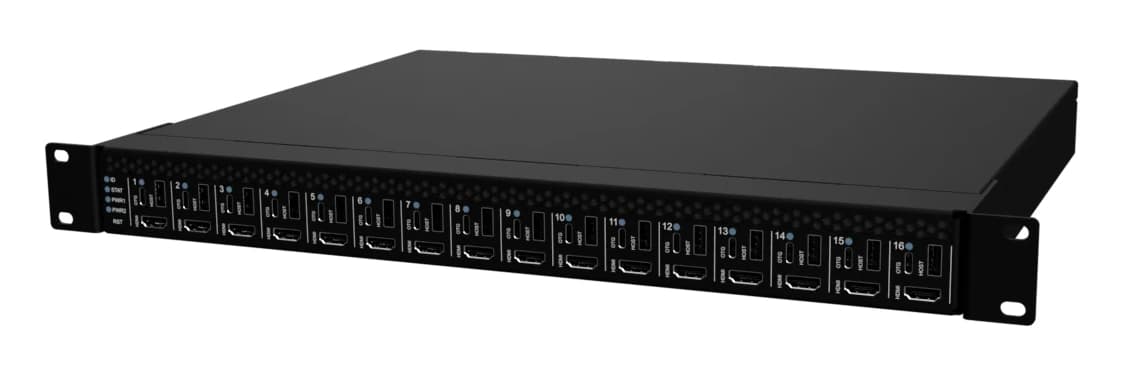
WK chassis: every port its own KVM
Every port is a complete KVM with its own capture and hardware encode, so 8, 16 or 32 targets all stream 4K at the same time, and a port that hangs cannot take its neighbors with it.
- 8 ports in a half-width 1U, 16 in a full 1U, 32 in 2U as two federated units
- 3840 x 2160 at 30 Hz on every port at once, hardware H.264 and H.265 per port
- One HDMI and one USB cable per target, plus a per-port USB-A host for serial adapters, peripherals and ATX control cards
- Each port module boots from a golden SPI image and updates A/B on its own 8 GB eMMC, rolling back on its own if an update fails; every port can be power-cycled remotely
- Redundant Ethernet inputs, dual redundant 250 W power inputs, a DC input option, and serial and USB management ports
- An option for US assembly with US-built PCBAs

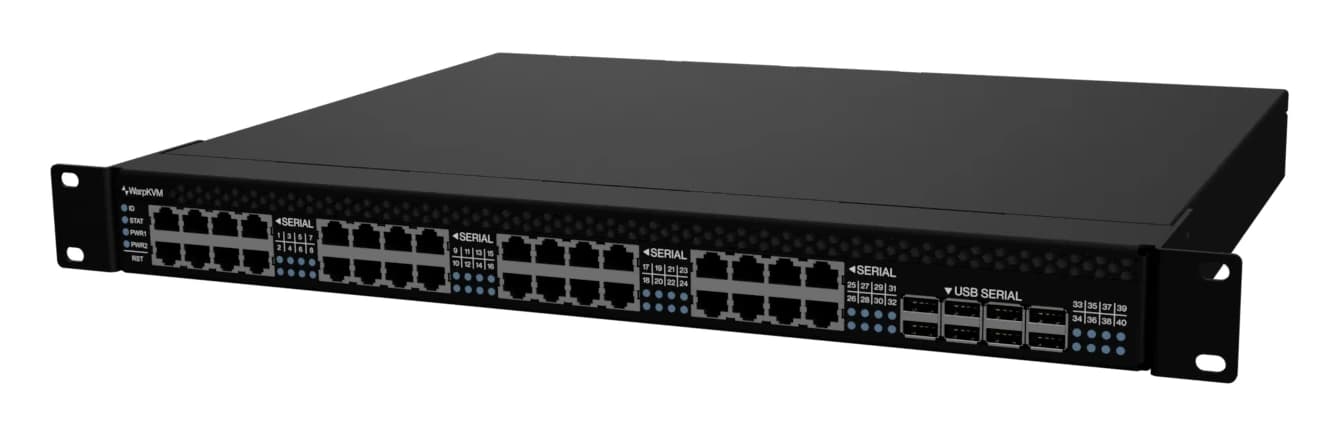
WO serial consoles
The out-of-band side: up to 48 RS-232 ports in 1U, in the same federation and audit trail as the KVM ports. Most of the work went into making a port configure itself.
- 16, 32, 40 or 48 RJ45 ports in the Cisco rollover pinout, with up to 8 USB-A hosts for USB-native consoles
- Each port senses DTE or DCE on its own, and detects a connected device from the RS-232 TX idle voltage
- Adapters carry an EEPROM, so a port identifies what is plugged in and configures itself
- A per-port RGB LED for present, session, fault and locate
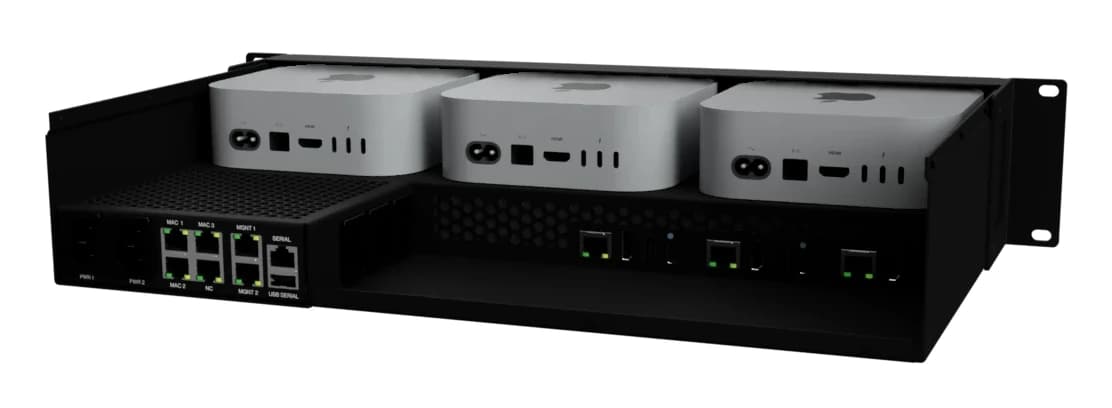
WM Mac mini tray
Three Mac minis in 2U, each fully managed. A Mac mini has no remote power control and no out-of-band port, so the tray adds both from the outside.
- A servo actuator presses each bay's physical power button: tap, force-off and the DFU hold, with a spring-return failsafe
- A USB-PD controller on each bay's DFU port for reboot, DFU entry and a serial console
- HDMI and USB capture per bay, from the same capture pods as the WK ports
- A and B feeds through an automatic transfer switch, with a relay, fusing and current telemetry per bay
- Fanless: bottom-intake plenum and rear exhaust; about 30 W idle and 500 W maximum
- Tenant traffic runs through three passive Ethernet passthroughs and never touches the tray's electronics; the bare enclosure can be upgraded to the managed version in the field
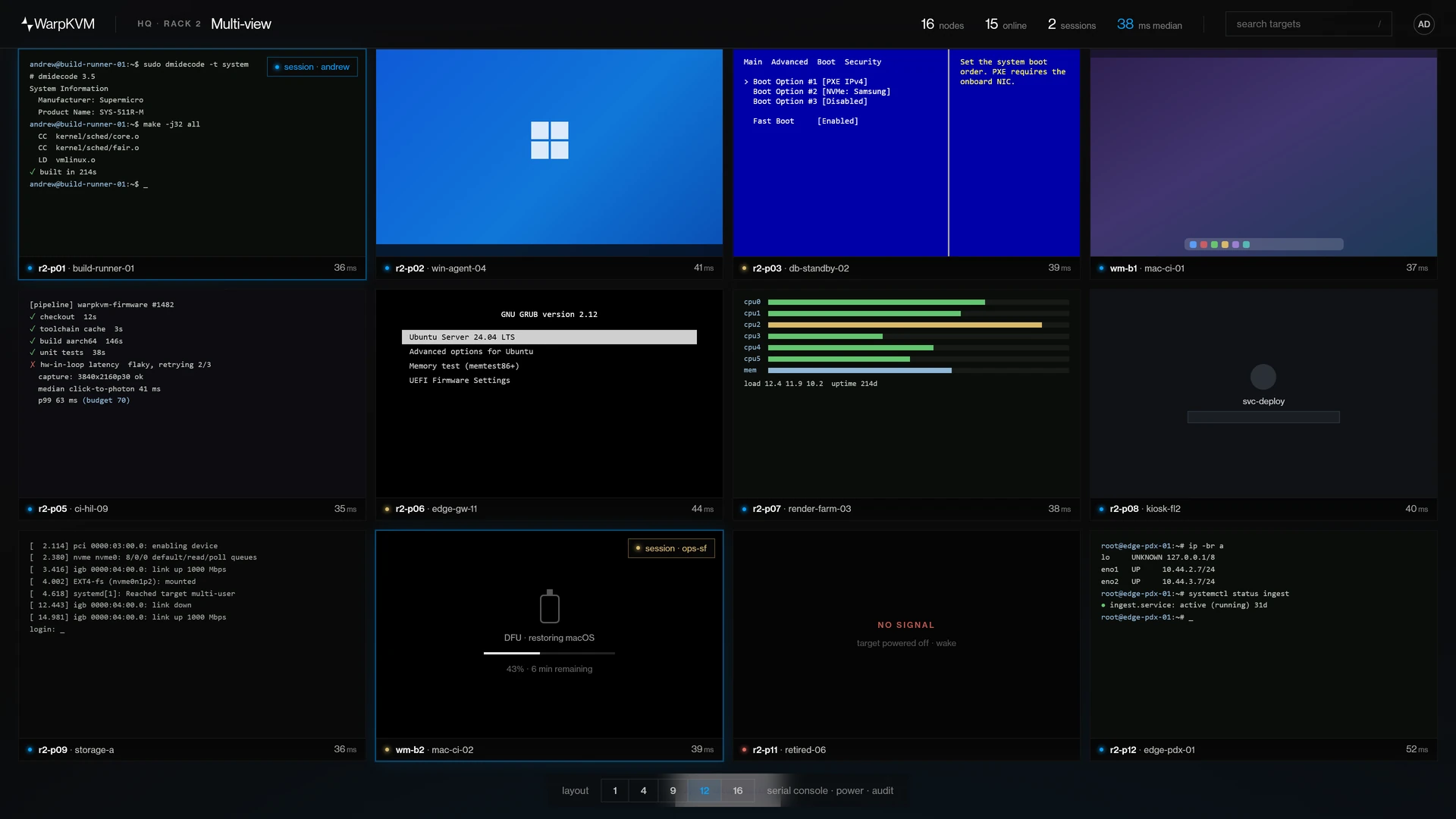
One management plane
Every unit runs the same management software, and a browser is the only client. Every KVM port, serial line and Mac bay on the federation shows up in one pane behind one IP and one login, with per-port permissions, session recording to onboard NVMe and a full audit trail. Port modules are never reachable from the customer network: the management and production networks are physically separate.
Where it stands
In development, with specifications preliminary until release. The single-port WarpKVM 01 ships first, in Q2 2027, on the same management plane. We are working with design partners on the rack line through warpkvm.com/enterprise.